Buyer's FAQ: Specifying Robot Spray Painting Cells with Turntables and Multi-Station Layouts

Why the turntable decision comes before the robot decision
Most spray painting cell projects start with a robot question: which model, what reach, what payload? In practice, the layout decision — single station, two-station turntable, or four-station rotary — determines cycle time, booth footprint, fixturing strategy, and even whether the robot can stay inside the booth continuously. Get the layout wrong and no robot specification will save the project.
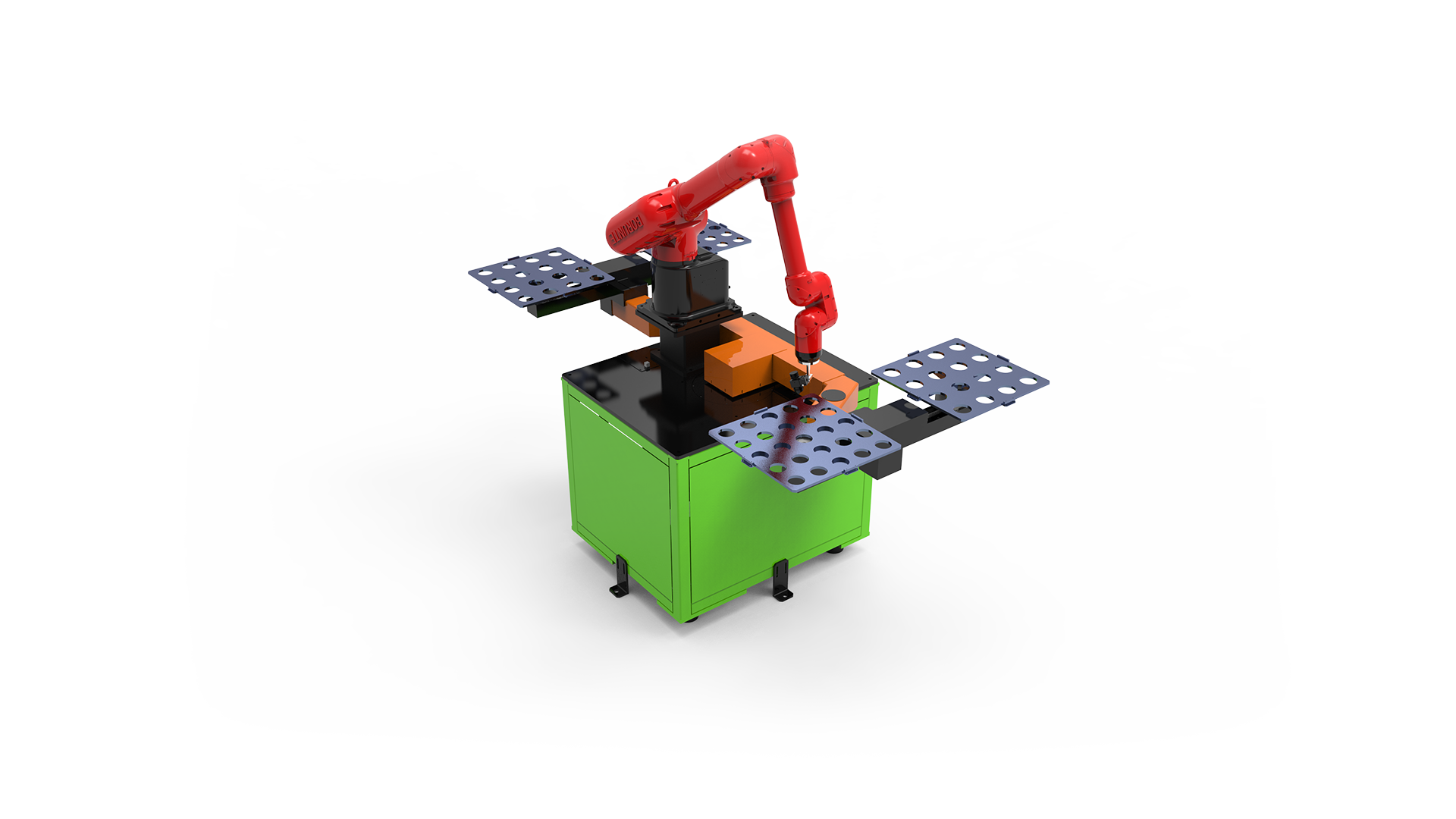
This guide walks through the specification questions buyers actually ask when planning a robot spray painting cell with turntables and multi-station layouts, using a four-station rotary painting configuration and a two-station turntable configuration as reference points.
Reference layout: a six-axis painting robot integrated into a four-station rotary cell. Part loading, spraying, and unloading overlap in time.
The problem buyers are actually solving
If you are specifying a painting cell, you are probably dealing with one or more of these:
- Throughput ceiling. Manual spraying caps output at the speed of the operator, and the operator cannot spray and load parts at the same time.
- Coating consistency drift. Film thickness and edge coverage vary between operators and between shifts, and the variation only shows up downstream at inspection or at the customer.
- Paint waste and overspray. Manual gun paths are inconsistent, so transfer efficiency is inconsistent too.
- Labor exposure. Painting is a role that is hard to staff, hard to retain, and carries health and safety obligations.
- Mix changeover. High-mix, low-volume production punishes any cell that requires long setup between part types.
A turntable or multi-station layout addresses several of these at once — but only if the layout is matched to the part family and the takt time.
Why automate spray painting at all
The case for automation in painting is not "robots are faster than people." It is repeatability and coverage reliability:
- Repeatable gun path and speed. A programmed path is executed the same way on part 1 and part 10,000. Film thickness becomes a process parameter rather than an operator skill.
- Coverage consistency across the part. Edge coverage and overlap are governed by the path and the spray parameters, not by how tired the operator is at hour six.
- Continuous production without fatigue drift. Runtime coverage decay — the slow drift in spray pattern and film thickness as equipment heats up over a long shift — is a known phenomenon in painting. Automation makes it measurable and compensatable rather than invisible.
- Paint and consumable discipline. Consistent gun distance, speed, and triggering reduce overspray and improve transfer efficiency.
- Flexibility for mixed production. With the right fixturing and station layout, changeover between part types becomes a program recall rather than a manual re-setup.
Solution logic: what a turntable layout actually buys you
The core idea behind turntables and multi-station layouts is overlapping operations. In a single-station cell, the robot sprays, then stops, then the part is swapped, then the robot sprays again. The robot is idle during load and unload.
In a turntable layout, the spraying position and the load/unload position are physically separated but connected by rotation. While the robot sprays station A, an operator (or a loading mechanism) unloads the finished part and loads the next one at station B. When the robot finishes station A, the table indexes, and spraying continues immediately.
Multi-station rotary layouts extend this further. A four-station rotary cell can dedicate stations to distinct functions — for example, load, pre-treatment or flash-off, spray, and unload — so that the robot is spraying almost continuously while the other stations handle their tasks in parallel.
What this means for specification:
- The robot becomes a spraying resource, not a part handler. The layout handles part movement; the robot focuses on gun path and coverage.
- Booth footprint and airflow become design constraints. More stations mean a larger enclosure, and booth airflow must remain stable across all station positions.
- Fixturing repeats per station. Each station needs its own fixture, and fixture repeatability directly affects coverage reliability.
- Indexing accuracy matters. The turntable's positional repeatability becomes part of the coating quality chain.
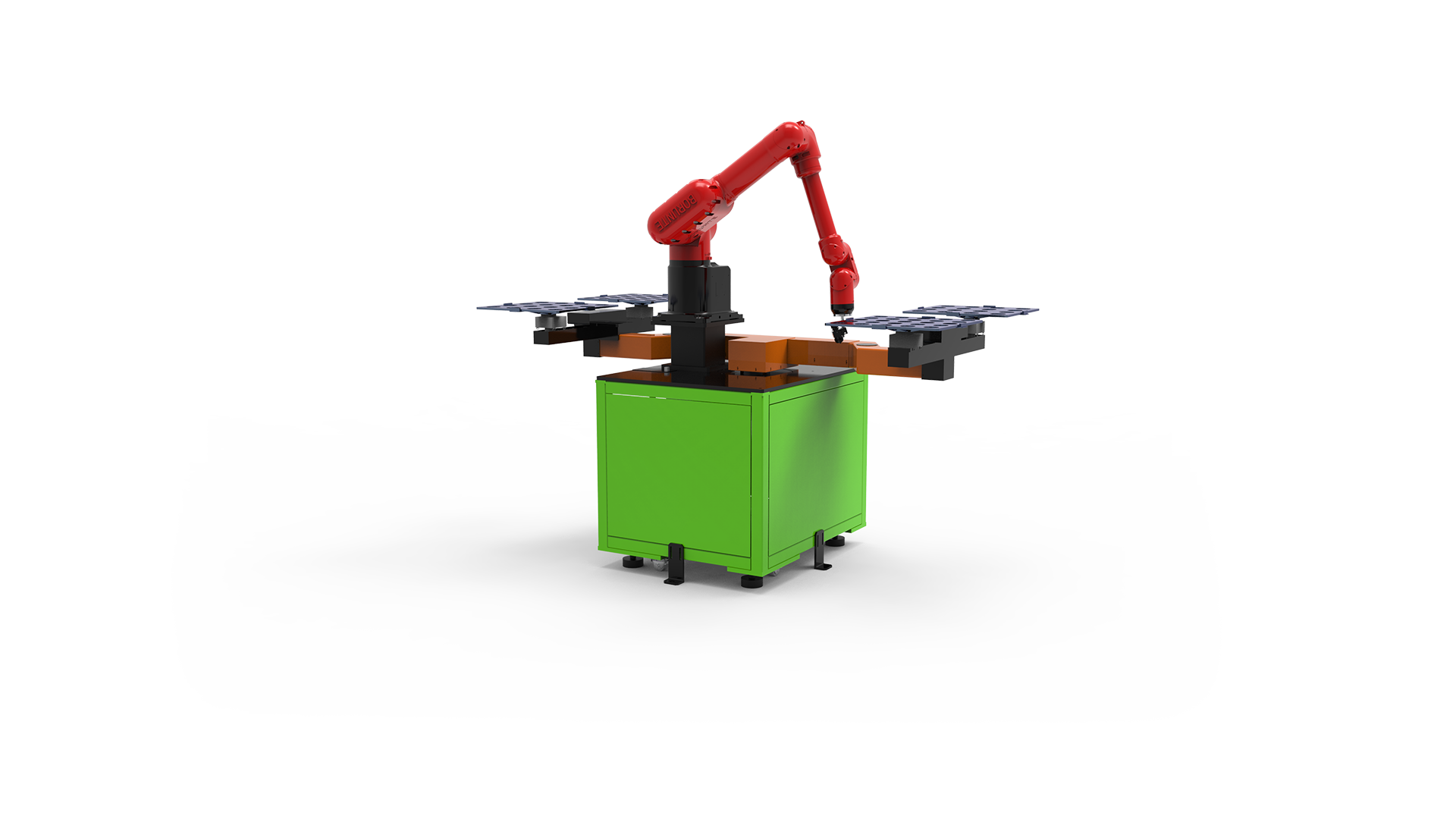
In a four-station rotary layout, load, spray, and unload overlap in time. The robot spends a higher proportion of each cycle actually spraying.
Key selection factors
1. Cycle time: calculate the real takt, not the spray time
The most common specification mistake is sizing the cell on spray time alone. The real cycle time in a turntable cell is:
Effective cycle time = max(spray time per station, load/unload time per station, index time) + overhead
If spraying takes 45 seconds and load/unload takes 40 seconds, a two-station turntable can approach a 45-second takt because the operations overlap. A single-station cell would be closer to 85 seconds plus index and door cycles.
For a four-station rotary layout, the constraint usually shifts to whichever station is slowest — often the spray station, but sometimes a pre-treatment or flash-off dwell.
Questions to answer before specifying:
- What is the required takt time, and is it driven by line rate or by batch size?
- How many parts per fixture, and can multiple parts be sprayed per station?
- What is the spray time for the largest part in the family, at the required film thickness?
- How long does load/unload realistically take, including operator walking and part handling?
- What is the turntable index time, and does it overlap with spraying or not?
2. Part fixturing: the quiet driver of coverage reliability
Fixturing is where many painting cell projects succeed or fail. The fixture determines part position, orientation, and repeatability — and therefore determines whether the programmed gun path actually produces the intended coverage.
Specification considerations:
- Positional repeatability. If the fixture locates the part differently by a few millimeters between cycles, edge coverage and film thickness will vary. Fixture repeatability should be specified in the same conversation as robot repeatability.
- Grounding and electrostatic compatibility. If the process uses electrostatic spraying, the fixture must provide a reliable ground path. Poor grounding causes uneven film build and can create safety issues.
- Masking and overspray protection. Fixtures often need masking features or protective coatings so that paint does not build up on locating surfaces and degrade repeatability over time.
- Cleaning and maintenance access. Paint accumulates. Fixtures that cannot be cleaned quickly will drift out of tolerance.
- Changeover. For high-mix production, tooling that can be swapped or re-datumed quickly matters more than theoretical cycle time.
3. Booth integration: airflow, access, and explosion-proof requirements
A painting robot cell is not just a robot in a room. The booth is an active part of the process.
- Airflow and overspray containment. Booth airflow must be stable and must not be disturbed by the turntable rotation or by robot arm movement. Downdraft design is common; the specification question is whether airflow remains uniform across all station positions.
- Explosion-proof requirements. This is a critical gating factor. Solvent-based paints create a hazardous atmosphere, and equipment inside the booth must be rated accordingly. Buyers should confirm the explosion-proof rating of every component in the hazardous zone — robot, gun, cabling, sensors, and turntable drive — against the classification of the specific paint and solvent being used.
- Gun and fluid delivery. Gun type, atomization method, and fluid delivery routing affect both coverage quality and maintenance. The specification should state the paint type, viscosity range, and required film thickness, because these drive gun selection.
- Access for maintenance. Robots, guns, and turntables need service access. Booth design that ignores this turns routine maintenance into a production stoppage.
- Ventilation and cure interface. If the cell feeds a flash-off or curing stage, the interface between the booth and the next stage becomes part of the cycle time calculation.
4. Robot specification for the spraying task
Once the layout, fixturing, and booth are defined, the robot specification becomes more tractable. The key parameters are payload, working range, and repeatability — but they must be read against the actual task.
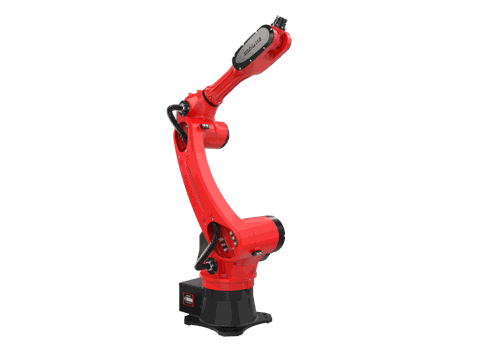
Using the BRTIRUS1510A as a reference example of a six-axis robot used in this type of cell:
| Parameter | BRTIRUS1510A | Why it matters in a painting cell |
|---|---|---|
| Axes | 6 | Wrist articulation for maintaining gun angle over complex part geometry |
| Payload | 10 kg | Must cover gun, mounting bracket, and any hose/cable management load |
| Arm reach | 1587 mm | Determines whether the robot can cover the full spray station from a fixed base position |
| Repeatability | ±0.05 mm | Contributes to path consistency; fixture repeatability must be comparable |
| Weight | 152 kg | Affects mounting structure and turntable/booth floor design |
| Power capacity | 5.06 kVA | Feeds into booth electrical design |
| Explosion-proof | Not supported on this model | Critical check: this model is not explosion-proof rated |
| CE certification | Yes (DPWD/03/0646/2025, 2006/42/EC + 2014/35/EU) | Relevant for EU market compliance documentation |
Robot parameters above are from the BORUNTE selection catalog. The BRTIRUS1510A is a BORUNTE robot model; YGT Robot integrates this platform into painting cell solutions.
Important note on explosion-proof: the BRTIRUS1510A is not an explosion-proof model. In painting applications involving solvent-based paints, the hazardous zone classification and equipment rating must be confirmed before specification. If your process requires explosion-proof equipment inside the booth, this needs to be resolved at the layout stage, not after the robot is ordered.
5. Turntable and indexing specification
The turntable is often treated as a commodity component and specified late. In practice it carries several critical requirements:
- Indexing repeatability — directly affects part position at the spray station.
- Index time — affects effective cycle time if it does not overlap with spraying.
- Drive location — if the drive is inside the hazardous zone, its rating matters.
- Load capacity and fixture weight — including the weight of the fixture plus parts plus any masking tooling.
- Rotation smoothness — abrupt indexing can disturb parts on fixtures and, in some cases, airflow.
6. Layout comparison: single station vs. two-station vs. four-station
| Layout | Cycle time behavior | Footprint | Fixturing | Best fit |
|---|---|---|---|---|
| Single station | Spray time + load/unload + door cycle, serial | Smallest | One fixture set | Low volume, large parts, long spray times |
| Two-station turntable | max(spray, load/unload) + index | Moderate | Two fixture sets | Medium volume, moderate part size, operator loading |
| Four-station rotary | Limited by slowest station; spray often continuous | Largest | Four fixture sets | Higher volume, multi-step process (load / treat / spray / unload) |
This comparison reflects general layout behavior. Actual cycle time depends on part geometry, film thickness requirement, and load/unload method.
How YGT Robot approaches painting cell integration
YGT Robot's role in painting projects is integration and application engineering, not robot manufacturing. The robot platform — such as the BRTIRUS1510A six-axis model — is selected from the BORUNTE range based on the task requirements; the cell design, fixturing concept, turntable integration, booth interface, and process parameters are engineered around the specific part family and production target.
In practice, this means the specification conversation covers:
- Part family analysis and spray time estimation per station
- Layout selection (single, two-station, four-station) against takt time
- Fixture concept and repeatability requirements
- Booth and hazardous zone interface
- Robot platform selection and reach/payload verification
- Turntable and indexing specification
- Integration of robot, gun, turntable, and control system
A reference configuration for this type of project is a six-axis robot integrated into a four-station rotary cell, where load, spray, and unload operations overlap to keep the robot spraying for a high proportion of each cycle.
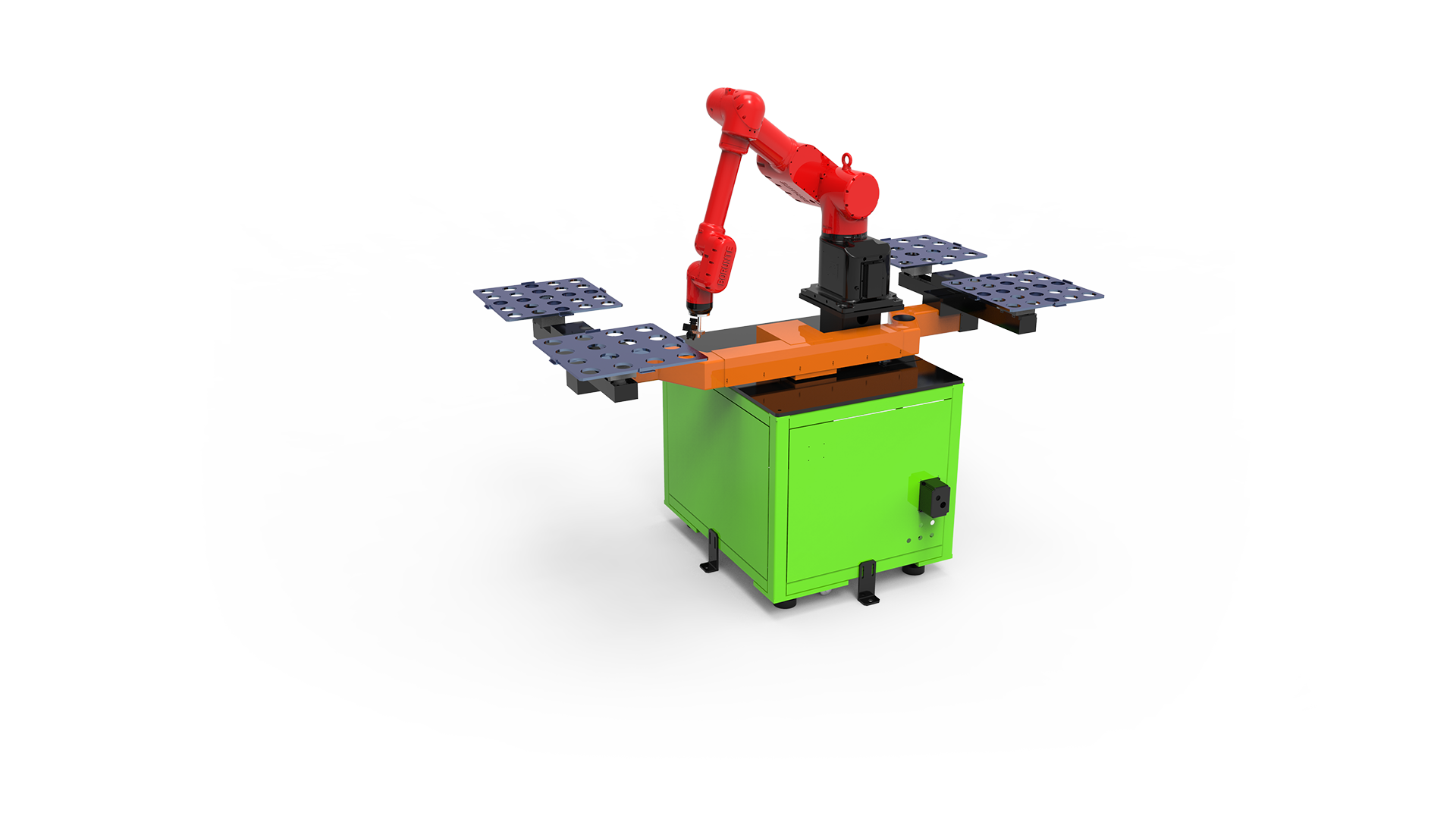
Integration view of a four-station rotary painting cell. Turntable, robot, and booth interface are engineered as one system.
FAQ
Q: How do I calculate cycle time for a two-station turntable painting cell?
Start with the spray time for the largest part at the required film thickness. Then measure or estimate load/unload time. In a two-station turntable, these two operations overlap, so the effective cycle time is approximately the longer of the two, plus turntable index time and any door or interlock overhead. If spray time is 50 seconds and load/unload is 40 seconds, the cell can approach a 50-second takt — not 90 seconds.
Q: When is a four-station rotary layout worth the extra footprint?
When the process has more than two steps that can be parallelized — for example, load, pre-treatment or flash-off, spray, and unload — or when the required takt is shorter than the load/unload time. A four-station layout also helps when the robot needs to spray almost continuously to meet line rate. If your process is simply spray and load/unload, a two-station turntable is often the more efficient choice.
Q: What fixturing repeatability do I need for consistent film thickness?
Fixture repeatability should be specified in the same range as the robot's path repeatability. If the robot repeats to ±0.05 mm but the fixture locates the part to ±0.5 mm, the fixture dominates the coverage variation. For most painting applications, fixture positional repeatability in the ±0.1 mm to ±0.2 mm range is a reasonable starting target, but the actual requirement depends on part geometry and film thickness tolerance.
Q: Does the robot need to be explosion-proof for a paint booth?
It depends on the hazardous zone classification, which is determined by the paint and solvent being used, the ventilation design, and local regulations. Solvent-based paints typically create a hazardous atmosphere inside the booth, and equipment in that zone must be rated accordingly. The BRTIRUS1510A is not an explosion-proof model. If your process requires explosion-proof equipment, this must be resolved at the layout and equipment selection stage. Buyers should confirm the zone classification with their process engineer and verify the rating of every component in the hazardous zone.
Q: Can the robot spray multiple parts per station?
Yes, if the fixture holds multiple parts and the robot's reach covers all of them from the spray position. This is a common way to increase throughput without adding stations. The trade-off is fixture complexity and the risk that one part's position affects the spray path for the others.
Q: What paint parameters should be specified before selecting a gun?
Paint type (solvent-based, water-based, powder), viscosity range, required film thickness, and acceptable surface finish. These determine the atomization method and gun selection. Specifying the gun before the paint parameters is a common cause of coverage problems later.
Q: How does the turntable index time affect cycle time?
If indexing happens while the robot is spraying, it does not add to cycle time. If the robot must stop and wait for the index to complete, index time adds directly to the cycle. In most well-designed cells, indexing overlaps with spraying at another station, but this depends on the number of stations and the process sequence.
Q: What is the typical integration scope for a painting cell project?
A typical scope covers part family analysis, layout selection, fixture concept, robot platform selection, turntable specification, booth interface, gun and fluid delivery integration, and control system integration. The robot platform is one component within this scope — the cell design and process integration determine whether the required coverage and cycle time are achieved.
Related products
Related cases
Next step
If you are planning a painting cell and want to work through the cycle time, layout, and fixturing questions against your actual part family, the useful next step is a specification review rather than a quote. Send us the part drawings, required film thickness, target takt time, and paint type, and we can work through the layout options and robot platform selection with you.